The phenomenon of radio waves reflecting off surfaces was discovered by German physicist Heinrich Hertz in 1888, and the Great Powers lost no time in exploiting the discovery for military purposes. When World War II started in September 1939 with Germany invading Poland, all the major combatants had a variety of functioning radar systems. In the UK, the technology was called Range and Direction Finding (RDF), while in Germany the name used was Funkmeß (radio-measuring), with equipment called Funkmessgerät (radio measuring device). The U.S. Navy fielded the first American systems in early 1940, and a year later the U.S. Army followed suit. The acronym RADAR (for RAdio Detection And Ranging) was coined by the U.S. Navy in 1940, and the word "radar" has stuck with us.
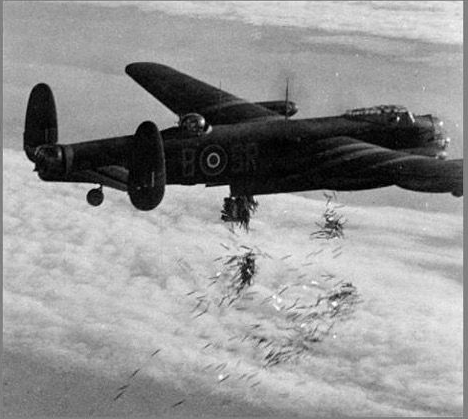
Of course, when there’s any military technology advancement countermeasures soon emerge. All the countermeasures to radar developed during the war are still in use today. One common one was “window,” or chaff, aluminum or metallized paper strips that created a false echo (the Japanese called the strips Giman-shi, or "deceiving paper"). The strips were designed to be roughly half the wavelength of the enemy radar, which caused a very strong reflection. The echo appeared as a cluster of primary targets on radar screens or swamped the screen with multiple returns. Initially chaff was simply thrown out open windows on bombers until development of a chute through which chaff was fed into the slip stream at timed intervals, as seen in the photo of a B-25 Mitchell bomber deploying chaff. Later, automatic chaff dispensing systems were developed. On D-Day, Operations Glimmer and Taxable dropped dozens of tons of chaff to fool enemy radar. These operations also mimicked invasion craft by using small radar deflector balloons below the chaff. By carefully regulating the drop frequency and aircraft position and speed, Glimmer and Taxable gave the impression of a seaborne invasion of Calais, while in Operation Mandrel RAF bombers flew around above the sea, using powerful transmitters to jam German coastal radar stations to hide the signals of the real fleet heading to Normandy.
There also were the first attempts at “stealth” in the form of radar-absorbing materials. For instance, the periscope and snorkel masts of the German Type XXI submarines were coated with “Tarnmatte,” a rubber-based material intended to produce a lower radar return. Radar-evading tactics were also quickly adopted, including flying very low or very high, both of which had severe drawbacks including safety, comfort, and weapons effectiveness. The last technique was the most direct: once the Allies had achieved air superiority in Europe they were able to seek and destroy German radar sites at will.